
Mechanisms That Keep News Enthusiasts Inside the Mainstream Media Box — And How to Break Free
Many daily news consumers see themselves as alert, informed, and serious. They follow headlines, recognize major officials, absorb expert commentary, and keep up with the approved vocabulary of the moment. Yet the same people may shut down fast when someone questions a dominant story about health policy, inflation, war, censorship, or institutional power.
That reaction is not just personal stubbornness. It grows from a larger information system that rewards trust in approved sources and treats deviation as a risk.
This does not mean every alternative theory is true. Many are weak, incomplete, or misleading. But the reflexive rejection of outside explanations is worth examining. A healthy public should be able to ask hard questions without treating doubt as a moral failure.
This is an analysis of media behavior and public psychology, not medical, financial, or legal advice.
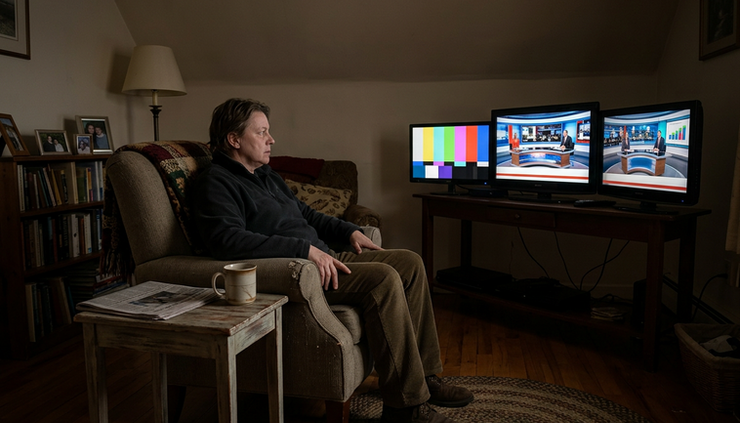
Institutional trust becomes a substitute for verification
The first barrier is institutional trust conditioning.
From childhood, people are taught that certain institutions carry authority. Schools, major newspapers, national broadcasters, universities, government agencies, and credentialed experts are presented as the proper sources of truth. That belief is not always wrong. Institutions can gather expertise, preserve records, check errors, and hold people accountable.
The problem begins when trust turns into dependency.
A viewer who has spent years treating legacy media as the gateway to reality may stop asking, “Is this claim well supported?” and start asking, “Did the right institution say it?” The brand becomes a shortcut for judgment. If a familiar outlet says a claim is legitimate, it feels safe. If an outsider says it, the same claim may feel suspicious before it is even examined.
This is how trust becomes an identity marker.
For many news fans, mainstream consumption is tied to self-image. They are not “uninformed.” They are responsible. They are reasonable. They are not the kind of person who falls for fringe ideas. When a competing explanation appears, it does more than challenge a fact. It challenges the listener’s sense of being careful and educated.
That is why disagreement can feel strangely personal.
A question about a war narrative, a pharmaceutical policy, a central bank decision, or a surveillance program may be heard as an accusation: “You were fooled.” Most people do not respond calmly to that. They defend the source that protected their identity.
Institutional trust also changes the burden of proof. Official claims often get accepted with modest evidence because they arrive through familiar channels. Alternative claims must clear a much higher bar, even when the official explanation has gaps of its own.
That double standard is rarely admitted. It appears as tone policing, source dismissal, or quick labeling. The question is no longer whether the claim is true. The question becomes whether the claim came from the right tribe.
Social cost keeps doubt private
The second force is social pressure.
People often imagine belief as a private act. In practice, belief has social consequences. What someone is allowed to question depends heavily on the workplace, family, friend group, school, and online environment around them.
Certain topics carry special risk. Health mandates, election rules, foreign conflicts, monetary policy, immigration, speech restrictions, and intelligence agencies can become loyalty tests. Even a cautious question can be treated as a sign of bad character.
That pressure works because people are social. Being mocked, isolated, unfollowed, reported, demoted, or labeled as dangerous carries a real emotional cost. Many people would rather stay silent than lose status.
This does not require a formal conspiracy. A culture can enforce boundaries through repeated signals:
Which opinions get praised as “responsible”
Which questions get mocked as “dangerous”
Which sources get dismissed before their claims are checked
Which people are treated as respectable after changing their views
Which people become warnings to others
Once those patterns become clear, many people learn to self-censor. They may notice contradictions. They may privately doubt a headline. They may see that a fact-check skipped the strongest version of a claim. Still, they say nothing.
The result is a public conversation that looks more uniform than it really is.
Silence can be mistaken for agreement when disagreement carries a price.
Platform moderation adds another layer. Large technology companies, search engines, video platforms, and payment processors can influence which voices are easy to find, share, or support. Some moderation is aimed at fraud, harassment, or dangerous claims. Some decisions are harder to evaluate from the outside. Either way, the effect is clear: people notice which subjects can trigger penalties.
When users see posts removed, accounts restricted, or channels demonetized, they adapt. They avoid certain phrases. They soften criticism. They stop sharing controversial material. Over time, the boundary of acceptable thought moves without any need for direct orders.
That creates a powerful lesson: asking the wrong question may be more costly than remaining confused.

Algorithms make consensus feel natural
The third mechanism is algorithmic reinforcement.
Most people do not experience the internet as a neutral archive. They experience it as a feed, a search result page, a suggested video list, or a news app. Those systems rank information. They decide what appears first, what disappears, and what gets framed as reliable or unreliable.
The public often treats search results as a map of truth. If the top results all support one view, that view can feel settled. If dissenting sources are buried, labeled, or attached to warning banners, dissent can feel fringe before a listener reviews the evidence.
Algorithms can create a curated reality.
This matters because repetition feels like confirmation. A person may see the same framing in a newspaper, a search result, a cable segment, a podcast ad, and a phone notification. Since the message appears in different places, it feels independently verified. In many cases, though, those channels are responding to the same official statements, wire reports, expert networks, or platform rules.
The result is the illusion of consensus.
Consensus can be real. Scientific and historical knowledge often grows through open challenge and accumulated evidence. But consensus can also be manufactured through narrowing the range of visible disagreement. If people only see approved debate inside a small frame, they may confuse exposure with proof.
This is especially strong during crises. Wars, pandemics, bank failures, mass protests, and elections create urgency. News systems move fast. Officials speak in confident tones. Platforms elevate “authoritative sources.” Users who ask for more evidence can be treated as reckless because the situation feels too serious for doubt.
That is exactly when independent thinking is most needed.
Crises are when errors become expensive. They are also when governments, corporations, and media outlets face the strongest incentive to manage public perception. A serious citizen does not need to reject official information. But a serious citizen should notice when the same message appears everywhere at once and dissent is framed as a threat rather than a claim to be tested.
Cognitive inertia favors easy answers
The fourth barrier is cognitive inertia.
Investigative thinking is hard. It takes time, patience, and a high tolerance for uncertainty. It requires reading past headlines, comparing primary documents when available, separating claims from evidence, and asking who benefits from a given narrative.
Most people are tired.
After work, family obligations, bills, and daily stress, a clean explanation is appealing. Mainstream reporting often provides it:
Here is what happened.
Here is who is responsible.
Here is the expert interpretation.
Here is what reasonable people should think.
That structure is comforting. It reduces mental labor. It gives the audience a finished conclusion instead of an open question.
Alternative explanations do the opposite. They create discomfort. They may require learning how central banks work, how clinical trials are designed, how defense contracts shape policy, how intelligence agencies influence foreign affairs, or how media ownership affects coverage. Some claims may be false, but checking them still takes effort.
Cognitive inertia is not stupidity. It is the human tendency to conserve mental energy. Once a person has built a worldview, every challenge to it creates work. New information must be tested, sorted, and possibly integrated. If the new information threatens a trusted institution, the workload becomes emotional too.
That is when people reach for shortcuts:
Dismiss the source
Attack the motive
Use a label
Demand impossible certainty
Retreat to authority
“That outlet is not credible.”
“They only believe that because they are angry.”
“That sounds like misinformation.”
“Unless you can prove every detail, I reject it.”
“Experts already settled this.”
These shortcuts can protect against nonsense. They can also protect a person from learning something uncomfortable.

The media system rewards compliance
News organizations operate under pressure. They compete for audience attention. They rely on access to officials, experts, donors, subscribers, advertisers, or parent companies. They must publish quickly. They must avoid legal risk. They must keep their audience from leaving.
These forces shape coverage.
A reporter who challenges a powerful source too aggressively may lose access. An outlet that offends its core audience may lose trust. A platform that allows controversial speech may invite political pressure. An expert who breaks with consensus may risk reputation and funding.
None of this requires every journalist to act in bad faith. Many reporters do sincere work under difficult conditions. But incentives matter. Systems produce patterns even when individuals mean well.
Mainstream news tends to favor stories that fit established frames. It is safer to quote officials than to accuse them. It is easier to interview credentialed experts than independent researchers. It is less risky to repeat a dominant view than to explore a claim that may later be labeled false.
The audience absorbs those incentives without seeing them. What appears as objective reality may be the final product of source selection, editorial caution, platform ranking, and social pressure.
That is why news fans resist independent thinking. They have been trained not only to consume information, but to recognize which information carries social permission.
Skepticism is not the same as contrarianism
A serious analysis must also address the obvious counterpoint: many alternative claims are wrong.
Some are built on weak evidence. Some rely on selective screenshots, anonymous rumors, or misunderstood documents. Some exploit distrust for profit or attention. A person who rejects every mainstream report simply because it is mainstream is not thinking independently. They are just reversing the same dependency.
True skepticism cuts both ways.
It questions officials, media outlets, influencers, anonymous accounts, and alternative commentators. It asks what evidence would change the conclusion. It avoids turning suspicion into a religion.
A better standard is not “trust the mainstream” or “trust the outsider.” A better standard is evidence, incentives, track record, and open debate.
Useful questions include:
What is the strongest evidence for this claim?
What evidence would weaken it?
Who benefits if this story is accepted?
Who pays a cost if it is questioned?
Are dissenting experts responding to the actual claim or a weaker version?
Has the official explanation changed over time?
Are primary sources available?
Is uncertainty being admitted or hidden?
These questions do not guarantee truth. They improve the odds of finding it.
How independent thinking can return
Breaking out of passive news consumption does not require rejecting all institutions. It requires changing the relationship to them.
Start by slowing down. A headline is not a conclusion. A fact-check is not always the final word. A viral clip is not full context. A government statement is not proof by itself. A credential is relevant, but it does not end debate.
Next, separate the claim from the messenger. A disliked person can make a true claim. A respected outlet can make a false one. Treat the evidence as the center of the discussion.
Read across disagreement. Not all sources deserve equal trust, but reading only one side creates dependence. Look for writers who quote original documents, represent opponents fairly, and correct errors when new facts appear.
Build comfort with uncertainty. Many public issues are not clean. Early reports can be wrong. Experts can disagree. Agencies can change positions. Markets can react before explanations arrive. Wars can involve propaganda from every side. The need for certainty makes people vulnerable to whoever offers it first.
Most of all, watch for emotional triggers. If a question makes you angry before you understand it, pause. Anger may signal that the claim is reckless. It may also signal that it touches a protected belief.

The real test is whether questions are allowed
A society that trusts its facts should not fear questions. It should welcome them, test them, and answer them in public.
When news fans resist independent thinking, the cause is rarely one flaw. It is a mix of institutional trust, social punishment, algorithmic filtering, and mental fatigue. Together, these forces make conformity feel like intelligence and doubt feel like danger.
The antidote is not blind rebellion. It is disciplined curiosity.
Read widely. Check primary sources when possible. Notice incentives. Let strong claims face strong questions. Refuse both lazy trust and lazy cynicism.
The goal is not to think outside every box for its own sake. The goal is to notice the box before mistaking it for the whole world.


Comments